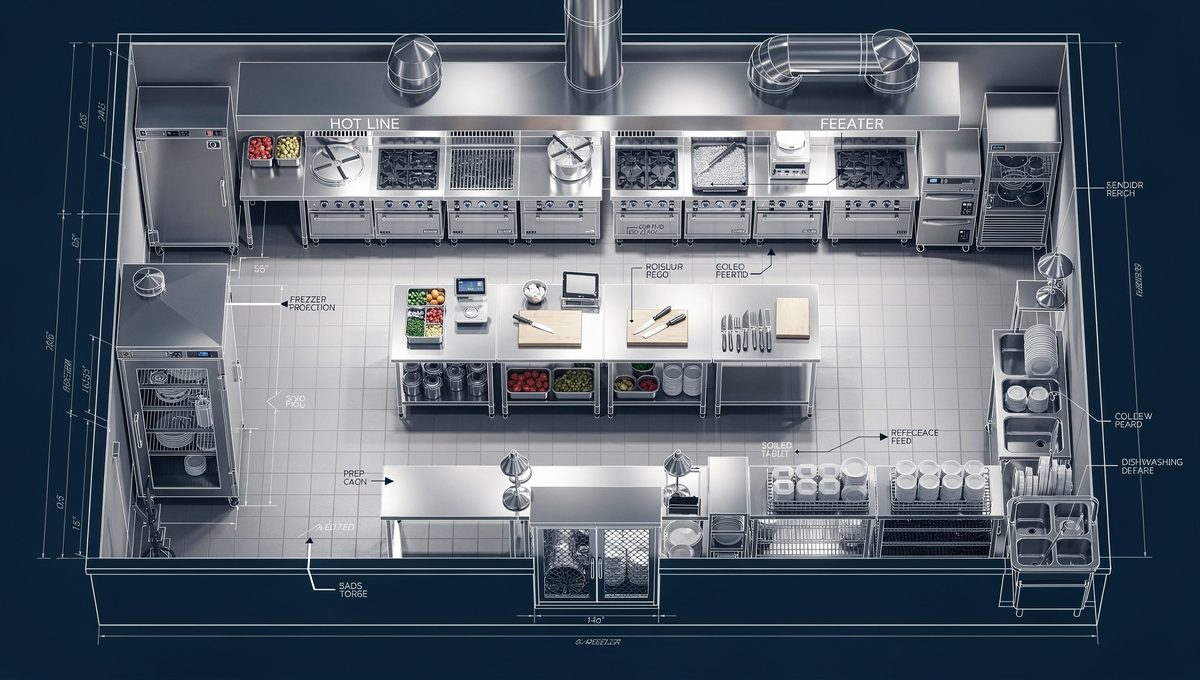
The Kitchen That Was Too Big to Work
When I first walked into the main kitchen at a Caribbean resort early in my career, it looked like a dream. Enormous. Gleaming. More space than any operator could reasonably want. On paper, that sounds like luxury. In practice, it was one of the most dysfunctional operating environments I have worked in.
Chefs were walking ten steps for every ingredient. Prep tables sat in the wrong relationship to refrigeration. The cold section was on the opposite side of the kitchen from the section that needed it most. Service slowed not because the team was working slowly — they were working very hard — but because the layout forced them to. Two chefs were doing work that a well-designed space would have allowed one to do. Every hour of service generated unnecessary labour cost that showed up in the weekly payroll without ever being attributed to its real cause: the floor plan.
It was not a food problem. It was a design problem. And design problems rarely appear as line items in a P&L review.
The Reach-In Fridge Problem
The single most common kitchen design error I encounter in both new builds and established operations is the reach-in refrigerator on the service line.
Reach-in fridges take up vertical space, force chefs to change posture constantly to access ingredients during service, and create a physical interruption in the flow of a station. They generate micro-delays — a second or two per access, repeated dozens of times per service — that compound into significant lost time. They also accumulate in ways that are difficult to audit because no individual access looks slow enough to flag.
The solution is under-counter drawer refrigeration. Drawers keep mise en place within arm's reach at station height, allow chefs to access ingredients without breaking the rhythm of service, and free up vertical space for equipment that actually contributes to throughput. The capital cost difference between reach-in fridges and drawer refrigeration is a fraction of what the labour inefficiency costs over a year of operation.
Brooksy Bar: A Case Study in Compact Design
At Brooksy Bar inside Amora Hotel Jamison in Sydney, the front-of-house design was strong enough to attract multiple design award nominations. But the most significant commercial design decisions were made behind the scenes, in the back bar — a space that had to produce volume with a fraction of the footprint of a conventional kitchen.
The brief was to build a food and beverage operation inside a bar environment where space was the primary constraint. Every equipment decision was made in relationship to every other decision, and the menu was engineered around the footprint rather than bolted onto it after the fact.
The core design principles: under-counter drawer refrigeration throughout, eliminating the reach-in fridge problem entirely. A sous vide station for precision cooking with minimal space and heat footprint. Air fryers to handle volume on fried items without the equipment weight and ventilation requirements of a conventional fryer. And a menu that was genuinely designed for the space — not a conventional bar menu squeezed into a kitchen that could not support it, but an offer that was conceived and tested in relationship to what the footprint could actually deliver.
The result was an operation that guests experienced as seamless — a bar that produced good food without the delays that usually signal a constrained kitchen. Behind the scenes, the team worked in a space that felt efficient and intuitive, which had a measurable impact on both output quality and staff satisfaction.
Wasted labour per year in a brigade of 10 chefs from poor kitchen layout alone — equivalent to 0.5 to 1 full-time role spent walking rather than cooking.
The Labour Maths of Kitchen Layout
Studies of commercial kitchen movement patterns consistently find that poor layout adds two to four kilometres of walking per chef per shift. At a walking pace of around five kilometres per hour, that is between 24 and 48 minutes of unnecessary movement per day, per chef.
Across a year of approximately 240 shifts, that is between 96 and 192 hours per chef lost to layout inefficiency — time that appears in the payroll as labour cost but produces no output. Scale that across a modest brigade of ten chefs and the range is 960 to 1,920 wasted labour hours annually. That is roughly half a full-time role to a full role, spent moving around a badly designed kitchen rather than cooking in a well-designed one.
The financial impact of that waste is straightforward to calculate for any operation: multiply the wasted hours by the average hourly cost of your kitchen team. The result is the hidden cost of layout inefficiency, and it almost never appears as a line item in any review of labour performance.
Where to Start Without a Full Redesign
Most of the operations I work with do not have the capital or the operational window for a complete kitchen redesign. The good news is that the most significant throughput and labour gains usually come from targeted changes, not comprehensive rebuilds.
The first intervention is always station audit: walk every station at the start of a service and track every reach, step, and lateral movement required to execute the most common items on the menu. The movements that repeat most frequently are the highest-return redesign opportunities. Eliminating ten seconds from a gesture that happens 40 times per service is worth more than optimising a sequence that happens twice.
The second intervention is equipment substitution: identify the pieces of equipment that generate the most unnecessary movement and replace them with alternatives that keep ingredients and tools within station footprint. Drawer refrigeration for reach-ins on the line. Mobile prep tables that can double as service support during peak periods. Induction stations that allow cooking surface to be positioned in relationship to refrigeration rather than in relationship to the ventilation hood.
The third intervention is menu alignment: review whether the current menu is asking the kitchen to do things the layout cannot support efficiently. Items that require chefs to leave their station footprint, cross the kitchen, or share equipment in ways that create bottlenecks are design liabilities. Sometimes the most efficient kitchen intervention is not a physical change but a menu change that eliminates the workflow problem the physical layout is producing.
What Good Kitchen Design Actually Delivers
The financial case for investing in kitchen design is straightforward: reduced labour cost per cover, improved output consistency, and measurable reduction in staff turnover related to physical fatigue and frustration. These are real numbers, and they accumulate significantly over time.
But the less quantifiable case is equally important. Chefs who work in well-designed spaces produce more consistent food because their execution is not interrupted by physical friction. They retain longer because the daily physical experience of the work is less exhausting. They train new team members more effectively because the space is logical rather than arbitrary. And they feel more invested in the quality of their output because the environment around them is treating that output as worth supporting.
Owners invest significantly in dining rooms, lighting, furniture and guest-facing elements. The kitchen, which is the single space that determines whether all of that investment is repaid through consistent food quality, is too often treated as a cost rather than as an asset. The return on treating it as an asset — in both financial and human terms — is consistently underestimated.