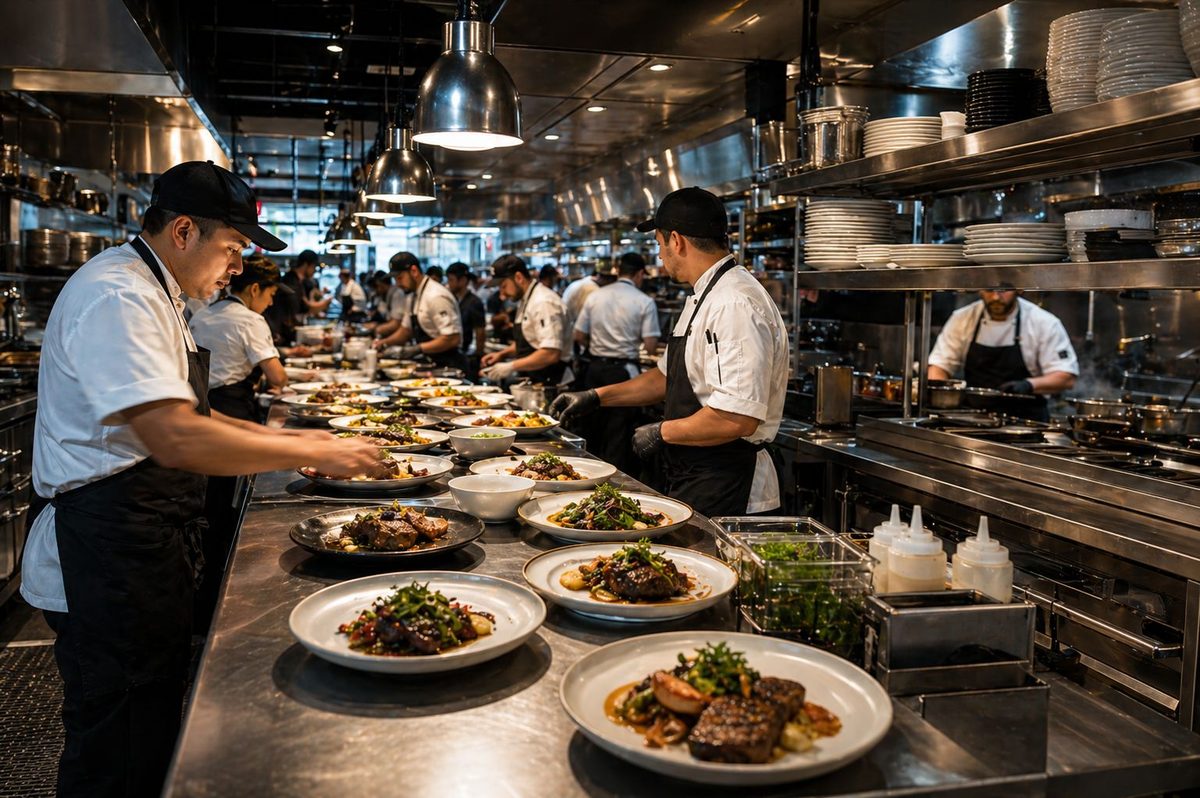
The Real Constraint in a Busy Kitchen
Every hospitality operator has experienced a service that went wrong despite having enough staff, enough food, and enough time to prep. Tables backed up. Tickets stacked. Quality dropped. Not because anyone was lazy or inexperienced — but because the system underneath the service had not been designed for the load it was carrying.
This is the throughput problem. And it is almost never solved by working harder.
The operations that consistently handle high volume without degrading — whether that is 200 covers at dinner, a 500-person event lunch, or a counter serving 800 transactions in a day — share one characteristic: they have removed as many in-service decisions as possible. Throughput is not energy. It is architecture.
Why Volume Breaks Most Operations
Most hospitality venues are designed for their average trade, not their peak. This works until it does not. When cover counts push above the everyday range, the gaps in the system surface immediately: unclear roles, fragmented mise en place, tickets that require interpretation, floor teams that are not linked to kitchen output.
Each small friction compounds. A three-second hesitation over which fridge holds a component, multiplied across 40 tickets in 90 minutes, becomes a structural delay. A verbal expo call that did not carry across a noisy pass creates a remade dish. None of these are dramatic failures — but together they erode the service.
The question for any operator thinking about throughput is not "how do we cook faster?" It is "where are our decisions hiding, and which ones can we eliminate before service starts?"
The Five Layers of Throughput Design
1. Menu architecture for volume
The menu is the first throughput lever and the most underused. High-volume operations consistently rely on an 80/20 SKU model — a relatively small number of items that carry the majority of orders. This is not about limiting choice for guests. It is about designing a menu that the kitchen can execute at speed and with consistency under pressure.
Items that require last-minute assembly from multiple stations are throughput risks. Items with long a la carte cook times are throughput risks. Items that share no components with other dishes are throughput risks — because they demand more mise en place, more fridge space, and more mental load from the team. When throughput is the priority, menu engineering and operational design must happen in the same conversation.
2. Station flow and linear sequencing
The physical flow of a kitchen determines how fast a dish travels from fire to pass. The most efficient high-volume kitchens run a simple logic: hot line fires and builds, garnish and sauce finishes, expo checks and calls. Each station has one job, and that job has clear entry and exit criteria.
Where kitchens struggle is in lateral dependencies — when a garnish station needs something from the cold section on the other side of the kitchen, or when the expo position requires the chef to make quality decisions that should have already been made at the station. Removing lateral movement from a service line is worth more than any equipment upgrade.
3. Two mise-en-place cycles
Peak service is execution time, not prep time. This sounds obvious, but many operations treat the hour before service as the last preparation window rather than a confirmation window. By the time first covers arrive, the mise en place should be complete, portioned, labelled, and staged. The service window is for firing, building, and passing — not for finding where something went or topping up a component that ran short.
The most disciplined operations run two mise cycles: a primary cycle completed well ahead of service, and a confirmation cycle 30 minutes before doors open that checks every station against the expected cover count and menu mix. Problems found in that second cycle can be fixed. Problems found during service are damage.
4. Role clarity and communication structure
In a well-designed high-volume service, every person on the floor and in the kitchen knows three things: what they are responsible for, who they communicate to, and what their escalation path is when something breaks. These are not complicated structures — but they have to be defined before service, not improvised during it.
The expo position is the axis of throughput in most services. One expo, consistent calling, grouped ticket firing, and a clear signal system to the floor for table readiness. Venues that use headsets or runner-to-floor communication consistently outperform those relying on verbal chains that break down in a noisy room. The technology is not the point — the communication architecture is.
5. Table turn and floor rhythm
Throughput is not only a kitchen problem. Floor pacing determines how efficiently covers cycle through the room. In high-volume environments, small design choices have large cumulative effects: whether menus are presented or on the table, how quickly water is poured and the first order taken, whether bills are pre-printed for predictable guest segments, how quickly reset happens between covers. None of these individually make or break a service — but together they determine whether a 150-cover venue does 200 covers or 240 in an evening.
The Principle Behind All of It
The best high-volume operators in the world — whether running a Michelin-level tasting menu at scale, a 500-seat hotel banquet, or a fast-casual brand doing thousands of transactions a day — share a single organising principle: the system does the thinking, so the team can do the executing.
When decisions are pre-made — what goes where, who calls what, which tickets fire together, how long a table waits before the floor checks in — the team's energy stays on execution quality. When those decisions are made in real time, under volume, with guests watching, quality degrades and payroll climbs.
Throughput is designed. And it is designed before service starts, not during it.
Applying This to Your Operation
Most venues do not need a complete rebuild to improve throughput. The audit is simpler than it sounds. Walk your service from ticket to table at your last difficult service and identify where decisions were made under pressure that could have been made earlier. Where was the last moment before service that those decisions could have been locked in? That gap is your throughput improvement opportunity.
Start with menu architecture, then station flow, then communication structure. These three together produce the majority of the gain. And the gain is not marginal — in operations where throughput has been properly designed, cover capacity at the same labour cost typically increases by 15 to 25 percent, with measurable improvement in consistency and staff stress.